
"I should be more grateful!". Do you ever think this to yourself?
Gratitude practice is one of the most consistently supported interventions in positive psychology, linked to better sleep, lower anxiety, and stronger relationships.
But when it's applied to situations that genuinely require action (such as abusive dynamics, systemic injustice, or circumstances that need to change) it can sometimes function as a form of self-silencing.
The problem isn't gratitude itself. Gratitude practice has actually been scientifically proven to stimulate the parts in our brain that are directly responsible for contentment.
But it can backfire if we use gratitude to quiet or ignore discomfort before we've understood what that discomfort is asking us to do.
More...
Discomfort Is Data
The Buddha often emphasized that there are no good and bad emotions - just emotions. We label them based on how we learned to feel about them.
Emotions exist because they carry information.
Neuroscientist Lisa Feldman Barrett’s research on how emotions are constructed shows that what we experience as negative affect is often the body's best prediction of what the current situation requires. Anxiety about an unstable relationship or an exploitative workplace is not a cognitive distortion you need to reframe. This is an important biological signal calling your attention that you might need to act upon something.
Of course, this is not an argument against ever using gratitude to shift perspective.
I'm a big believer of daily gratitude practice because it's easy to fall victim of a scarcity mindset (i.e. how many things we don't have) and gratitude practice helps reframe that, bringing more sense of satisfaction in your days without killing your motivation for growth and striving for better.
But when you reach for a gratitude journal the moment discomfort arrives, you interrupt that signal before you have understood what it is trying to tell you. Psychologists call this emotional suppression. The clinical costs are well-documented: suppressed emotions do not disappear, but instead tend to intensify or surface sideways.
And this is exactly why forced positivity can be so toxic.
There is a difference between "focus on the bright side of life" and "the glass half full", versus "pretend that your shadows don't exist".
The Seesaw Effect a.k.a. Building a Ledger System
For a long time in my early twenties, I kept a kind of mental ledger about a relationship I stayed in too long.
Because when it was good, it was genuinely really freaking good. I felt real support, real encouragement, someone who believed in my potential when I was still figuring out what that meant, and pushed me in the best possible way to be more adventurous, dare to dream bigger and grow as a human.
But there was also a truly dark side: the alcohol abuse, the aggression, the instability, the constant walking on eggshells because I never knew which side would come out of him in a given moment.
I didn't leave, because I kept telling myself that the scale was roughly balanced: the pros made up for the cons.
What I was actually doing was using gratitude as an accounting system.
It took me years and oh-so-much pain to understand that a relationship is not a math equation. The presence of genuine good does not cancel out the presence of genuine harm.
And that the flawed version of gratitude I was practicing (the one that kept saying "but look at all this data - look at all he has done for you and how he makes you feel!) was not helping me see clearly. It was helping me stay.
(I have to admit though: even this story has a silver lining. I'm pretty sure that this relationship is the main reason Grit Journals was eventually born in 2018.)
It might be more common than you think
The seesaw problem doesn't only show up in personal relationships. It shows up anywhere where we are asked to be grateful for partial goods inside a system that is causing harm.
Here's a totally hypothetical example:
When a government that has spent sixteen years concentrating power points to a popular policy (no income tax under 25, say) and asks But aren't you grateful for all we did for you? when you raise your voice against the collapse of healthcare, education, and basic human rights, that is the seesaw in political form. The question is designed to redirect attention from the structural harm toward the specific benefit.
Gratitude, practiced without discernment here, becomes a reason not to act against the system. And the evidence that it can work is everywhere: it is harder to mobilize people who feel they have something to lose, even when what they stand to lose is smaller than what is already being taken.
"It is harder to mobilize people who feel they have something to lose, even when what they stand to lose is smaller than what is already being taken." — @GritJournals_
The domestic version is starker.
Research on why people stay in abusive relationships consistently finds that intermittent reinforcement (that is, the cycling between harm and care, threat and kindness) makes the relationship harder to leave, not easier.
When gratitude attaches itself to the caring, "good" moments, it becomes one more reason to recalibrate toward staying. This is a predictable outcome of applying a tool designed for stable, basically-good situations to one that is neither.
So does that mean you shouldn't feel grateful for experiencing those good moments?
No, if you understand that you can be grateful and choose to move on regardless.
To this day, over 10 years after ending the relationship, I feel immense gratitude towards the opportunities my ex-partner helped me seize and I know I'm better without him.
The problem is that gratitude is often used (subconsciously, of course) as an invitation to run the seesaw calculation one more time.
Three Questions Worth Asking During Hardship
While gratitude practice can help you cope with difficult moments, it's worth checking in with yourself first: are you masking the pain or genuinely just finding data for things to be thankful for?
1) Is this discomfort asking me to accept something, or to change something? Grief, loss, and the ordinary frustrations of a basically-good life are often asking for acceptance. Chronic anxiety about a relationship, a job, or a situation that keeps producing the same harm is often asking for action. These require different responses. Gratitude is well-suited to the first. Applied to the second without analysis, it tends to delay the response without resolving the cause.
2) Am I using gratitude to feel better, or to see more clearly? These are not the same goal. Feeling better is a legit goal but if it comes at the cost of seeing a situation accurately, it is a short-term trade with a long-term price. The most useful gratitude practice is one that sharpens perception rather than obscuring it, allowing you to see what is actually here, in full, including the parts that are hard.
Did you know?
The My Reflective Month journal helps you face similarly hard questions, helping you gain clarity and closure)
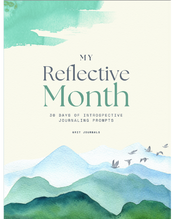
3) Am I practicing gratitude because I'm worried that if I feel negative emotions towards someone or something (e.g. anger, disappointment), I'm ungrateful? Respecting your own boundaries and worth is not lack of gratitude, but a strong and healthy manifestation of self-respect. Do you respect yourself enough to not settle for harm just because you also gained something from a situation?
The version of gratitude that has any real power is the kind that can hold a clear-eyed view of difficulty alongside a genuine appreciation for what is good. That is harder than writing three things down in the morning. It requires you to have actually looked at the whole picture first, including the parts you would rather not.
Anger, dissatisfaction, grief are not failures of perspective. Sometimes they are the most honest thing in the room. The work is not to dissolve them faster. It is to understand what they are pointing at before you do.
In case you want to build a gratitude practice, try our Morning Mindset guided journal or the My Reflective Month introspective prompt journal for taking a deep, honest look at your life and how you can keep going stronger and healthier, without hiding.
If you liked this article, please support us with a share!
Frequently Asked Questions
Can gratitude practice be harmful?
Gratitude practice itself is not harmful. In fact, it has strong scientific support for improving wellbeing and life satisfaction. It becomes counterproductive when used to suppress or redirect attention away from discomfort that is signalling something important, such as an unsafe situation, a relationship that needs to change, or a circumstance that requires action rather than acceptance.
What is the difference between gratitude and toxic positivity?
Toxic positivity is the insistence that a positive frame should be applied to all experiences, regardless of whether that is accurate or useful. Gratitude practice, at its best, is about training attention toward what is genuinely present and good, without denying what is difficult. The two overlap when gratitude is used to justify tolerating circumstances that are actively harmful.
How do I know when to use gratitude and when to act on my discomfort?
A useful starting question is whether your discomfort is asking you to accept something or to change something. Grief, uncertainty, and ordinary frustration often ask for acceptance, and gratitude can help. Chronic anxiety or anger about a specific situation that keeps producing harm is often asking for a response, not a reframe. Read the signal before you reach for the practice mindlessly.
Is it possible to be grateful and still want things to change?
Yes, and this is arguably the most functional form of gratitude. Appreciating what is genuinely good in a situation does not require pretending that everything is fine or that nothing needs to change. But the two can coexist. The problem arises when gratitude for partial goods is used as a reason to stop asking whether the overall situation is acceptable. As with everything, use this practice mindfully, intentionally and with critical thinking.